Steve Winwood Back in the High Life Again Meaing
| Dorsum in the High Life | ||||
|---|---|---|---|---|
 | ||||
| Studio anthology by Steve Winwood | ||||
| Released | xxx June 1986 | |||
| Recorded | August 1985 – May 1986 | |||
| Studio |
| |||
| Genre |
| |||
| Length | 45:03 | |||
| Label | Isle | |||
| Producer | Russ Titelman, Steve Winwood | |||
| Steve Winwood chronology | ||||
| ||||
| Singles from Back in the High Life | ||||
| ||||
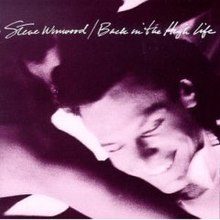
Back in the High Life is the fourth solo anthology by English singer, songwriter, and multi-instrumentalist Steve Winwood, released on xxx June 1986.[1] The album proved to be Winwood's biggest success to that date, certified Aureate in the UK and 3× Platinum in the Usa, and it reached the meridian twenty in most Western countries.[two] [3] It collected iii Grammy Awards[4] and generated 5 striking singles, starting with "Higher Dearest", which became Winwood'south first Billboard Hot 100 number-ane nautical chart topper, coming 20 years after he first entered that chart with "Continue on Running" past the Spencer Davis Grouping.[5] Other global hitting singles from the album were "Freedom Overspill", "Back in the High Life Again" and "The Finer Things". The single "Split Determination", with ex-Eagles guitarist Joe Walsh, was a US hit.[half-dozen]
Musically, the album was polished and sophisticated, representative of pop product in the 1980s, featuring Winwood's fashion of layered synthesizers and electronic drums that he had established with Arc of a Diver (1980). Unlike his two prior albums, on which he played every musical instrument himself, Winwood fabricated extensive use of session musicians for this album, including Joe Walsh and Nile Rogers on guitars and JR Robinson on drums. Winwood himself besides performed on a large number of instruments, combining live-played instruments with synthesizers and programming. Prominent backing vocals were provided by established stars, including Chaka Khan on "Higher Honey", James Ingram on "Finer Things", and James Taylor on the title rail. The album showcased Winwood's lifelong fascination with the fusion of styles, bringing folk, gospel and Caribbean sounds into a rock, pop and R&B milieu.[1] [two] [7] As with his previous albums, Dorsum in the High Life served as an uplifting alternative to the aroused or political punk that was sweeping the rock world.[8]
The album was recorded and released during a time of significant change in Winwood'southward personal life. Subsequently touring Due north America to promote the album during August–Nov 1986, Winwood divorced in England and and then married in New York City. He bought a second home in Nashville, where he organized his next project, Chronicles, a retrospective album of before songs, including some remixes engineered by Tom Lord-Alge, whom Winwood had befriended in the making of Back in the Loftier Life.
Background [edit]
Winwood's solo career had seen success in the UK with Steve Winwood in 1977 and Arc of a Diver in 1980, the latter being his first major solo United states hit, reaching number 3 on the Billboard 200. His 3rd album, Talking Back to the Night (1982), generated less of a response and was considered a permit-down. The concluding two albums had been created by Winwood playing all the instruments himself at his technologically advanced Turkdean dwelling studio "Netherturkdonic,"[9] but for his side by side project Winwood returned to working with other musicians for additional inspiration. He hired Los Angeleno Ron Weisner as manager, known for his work with Madonna and Michael Jackson.[x] Weisner pushed Winwood to record in London rather than at his dwelling house, where he was having relationship difficulties with his wife, Nicole. Winwood agreed to the London suggestion, but Weisner responded, "Well, forget London. Maybe you should become to New York."[viii]
Winwood was already acquainted with New York, having stayed at the Central Park South apartment of Chris Blackwell, the founder of Isle Records.[11] Blackwell had been serving every bit Winwood's quasi-manager for a few years, only Winwood was intent on moving in a new direction with Weisner. Weisner encouraged him to cease standing half-hidden behind the Hammond organ and accept his position every bit front homo and entertainer.[eight] [12] [13] Winwood said in 1988, "I fabricated a conscious effort to start working with musicians and producers and engineers. I got a manager. I have to say that those people are directly or indirectly responsible for my success now."[8] [14] Betwixt sessions for Back in the Loftier Life, Winwood booked another studio, where he scored synthesizer-based music for the documentary The High Life, about the 1985 Tour de France experience of Scottish bicycle racer Robert Millar (later known as Philippa York). The documentary was produced past ITV Granada; it aired in the weeks leading up to the 1986 Tour de France, in which Millar competed.[7] [xv]
Writing [edit]
Songwriting for the album began afterward Talking Back was released. Winwood wrote his own music merely he usually relied on other lyricists. He collaborated again with Texan Volition Jennings, a professor of English who had written the words to Winwood'southward song "While You lot Come across a Take a chance", a hit single in 1981. For this new projection, Winwood's quaternary solo album, the pair composed five more songs, two of which would go the biggest album hits: "Higher Dear" and "Back in the High Life Again". Jennings carried the phrase "Back in the High Life" effectually as a vocal title idea written down in a notebook, but when he was at Winwood'southward business firm in late 1984 he wrote the rest of the lyric in a half hour, without any music. More than a year afterward, Winwood finally wrote the music, after beingness nudged to do so by Titelman, who was notified of its being by Jennings. "Dorsum in the High Life Again" came very nigh to existence missed altogether.[16] Winwood said about teaming with Jennings, "Nosotros've got absolutely no rules when we work together. Sometimes we kickoff with the lyric, sometimes with the tune; sometimes we showtime with chorus and add the verses, and sometimes I write some of the lyrics myself. There are no formulas; things just happen naturally."[17]
A second return collaborator was eccentric English songwriter and old Bonzo Domestic dog Doo-Dah Ring frontman Vivian Stanshall, who had written the words for Winwood's "Dream Gerrard", actualization on Traffic's 1974 album When the Eagle Flies. The ii ofttimes traded favours: Winwood played on both of Stanshall's solo albums in the 1970s. More recently, Stanshall had come up upward with the lyric to the song "Arc of a Diver", which provided the 1980 album championship.[18] Stanshall joined with Winwood to create a demo version of "My Beloved's Leavin'" at Netherturkdonic, engineered by Nobby Clarke, who was Winwood'south right-hand man at the studio and on the route.[nineteen] Stanshall likewise wrote the lyric to "If That Gun is For Existent" in the early '80s, which was under consideration for Dorsum in the Loftier Life only was ultimately left off.[xviii]
The third returning lyricist was George Fleming, an sometime friend of Winwood's and the nephew of James Bond creator Ian Fleming. George Fleming had written two songs for Arc of a Diver – "Second-mitt Adult female" and "Dust" – which were his first-e'er compositions.[9] In 1985, he brought Winwood the words for "Freedom Overspill". Winwood wrote nearly of the music for "Freedom Overspill", with significant contribution from ex–Amazing Rhythm Ace James Hooker, an American keyboard player who toured in Winwood'south band starting in 1983.[xx]
Recording [edit]
Power Station, Right Track Recording, and Giant Sound sessions [edit]
"The timing was right. Stevie was ready to try something dissimilar. He had been working on tracks for about a year and some of the songs were demoed pretty seriously. I wasn't brought in for any desperate changes. I remember he might accept wanted to have some responsibleness off his ain shoulders."
—Russ Titelman on being selected as co-producer[21]
In July 1985,[10] Winwood settled into New York City for August recording sessions at Ability Station, getting an apartment off Madison Avenue near Central Park Zoo. Russ Titelman was called to co-produce the anthology considering he was already familiar with Winwood's keyboard work on Titelman's earlier productions George Harrison (1979) and Christine McVie (1984).[21] Titelman had also produced the Rufus/Chaka Khan song "Ain't Nobody", which won the artists a performance Grammy in 1984, and was 1 of Weisner's favorite songs, aiding in the selection of Titelman.[22] Tracking began in Studio C at Power Station under engineer Jason Corsaro, with Winwood laying down drum machine, synth bass, and some vocal and instrument tracks. Drummer Jimmy Bralower assisted with the programming of electronic drums, even going to Winwood'southward apartment to piece of work out the sequencing for "Back in the High Life Again", featuring a conga loop devised by Bralower on the Roland TR-808.[23] Corsaro also engineered sessions at Right Track Recording. When Corsaro had to exit to award a commitment with Fleetwood Mac,[24] Titelman moved the projection to Giant Sound for a couple of weeks in Oct.[25]
The Lord-Alge brothers' involvement and Unique sessions [edit]

Session keyboard histrion Robbie Kilgore told Winwood and Titelman that he knew iii talented brothers who engineered at a nearby studio with a wide selection of synthesizers: Chris, Jeff and Tom Lord-Alge at Unique Recording Studios.[26] [27] Kilgore took Titelman to Unique, where they discovered that the studio also had an SSL 4000E mixer just similar Winwood's at Netherturkdonic, so Titelman moved the projection there in early Nov 1985.[21] Titelman was immediately impressed past the speed of Chris Lord-Alge.[24] [28] Winwood was delighted with all the choices of synthesizer, playing on them during all-night jam sessions in which he invited any interested musicians to join him.[29] In the end, he stuck with a few favorites, including the familiar Hammond B3, a Minimoog, a Yamaha DX7, and a Roland Juno-60.[21]

Chris Lord-Alge was the more than accomplished of the iii engineer brothers, but he had been pushing Tom into positions of greater responsibleness; Tom earned his manner to become head engineer on the Winwood album, his first time in the role.[30]
Back in the High Life was mixed through May 1986 by Tom Lord-Alge in Unique's Studio B on the 48-channel SSL 4000E. A pair of linked 24-track record recorders was initially mixed down to stereo on a Studer A-eighty half-inch 2-track deck.[31] [32] At one indicate the analog Studer stopped working and the mixdown was shifted to a digital Mitsubishi X-eighty open-reel 2-track recorder. The greater sonic clarity accomplished this way was profound plenty for Titelman and Winwood to decide that the whole album must exist mixed to digital stereo.[24] Tom said that Winwood taught him a few tricks on the SSL, and Tom returned the favour past showing Winwood a trick or ii of his ain.[26] Titelman said Tom "uses the SSL like a player uses an instrument".[24] According to Tom, between 10 and 20 pct of the Ability Station and other previous tracks ended up on the album. The great bulk of Back in the High Life came from overdubbing at Unique.[26]
Drums [edit]
In one case Winwood settled in at Unique, Titelman decided to bring in a real drummer to augment or supersede the drum auto parts. On tape, the album already had Roland, LinnDrum and Simmons electronic pulsate sounds, but these were non setting the right tone for many of the songs. Session drummer John "JR" Robinson was called in from a nearby George Benson session, bringing his own pulsate equipment.[33] JR had already worked with Titelman on Rufus and Chaka Khan dates, and he had many hit records under his belt, including the charity single "We Are the Earth" and Michael Jackson's multi-Platinum "Don't Stop 'Til You Get Enough". To get a larger-than-life drum sound, Titelman and the Lord-Alge brothers had the drums placed in the eye of the primary room of Studio B, with eight additional microphones positioned around the room to capture sound-wave reflections and increase the ratio of room ambience.[21] [34]
"College Love" was commencement tracked with a uncomplicated pulsate machine loop, which Titelman felt was "flat", not quite fitting with the synth layers, which had been created mainly by Kilgore. Titelman tried replacing all the electronic drums with JR playing live, just the producers felt that this, too, was not quite suitable.[34] Instead, the rhythm part for the song was synthetic as a combination of electronic drums, JR'southward live drums, and sequenced samples of JR's drums added later.[24] Winwood instructed JR to make the snare overdubs feel like they were slightly rushing the tempo, to add excitement.[34] JR noted that Winwood asked for high-pitched, vivid sounds from the drum kit, so he chose brass snares such equally a vintage 1930 Ludwig for "Split Decision", and the vintage Black Dazzler on "Higher Dearest". JR tuned his drumheads high to satisfy Winwood, dissimilar another of JR's bandleaders, Bob Seger, who wanted merely low-pitched drums.[33] Real drums augmented or replaced the electronic drums on every song on the album except "My Love'south Leavin'", on which the drum parts stayed purely electronic.[21]
"Higher Love" drum-make full [edit]
Tom says he "clinched the gig" when he made a suggestion to Titelman as the overdubbing was winding down and mixing was soon to begin. The proffer involved Tom moving one of JR's impromptu drum fills to the beginning of "Higher Love", by assigning a timing outset to 1 of ii record machines such that they first played the drum fill followed by the song coming in on the beat out.[27] Titelman was very happy with the result, and decided to open up the album with this drum fill. The opening eventually became so famous that JR put information technology on his answering motorcar as a professional person calling card. JR said the pattern was a Latin rimshot technique beyond the height of his classic seamless brass Ludwig Black Beauty snare, unmuffled, with its snare wires disengaged, to emulate the sound of a timbale. He said, "it's ane of the all-time drum intros I've always played."[33]
Titelman remembered the fill being played ad lib by JR while his friend Chaka Khan was preparing to sing her background vocals on "Higher Dear", causing Khan to exclaim "What is that shit? Information technology sounds like voodoo shit!"[22] Tom Lord-Alge agreed that the drum fill was played as a distraction after JR had completed his drum overdubs for "College Love". Tom said, "It was i of those happy accidents, and it happened because Chris always taught me that if the tape is rolling and there'southward a musician in the studio, make sure the record machine is in record!"[27]
Notable collaborators [edit]

Joe Walsh co-wrote "Split up Determination" with Winwood
Titelman tapped James Taylor to add background vocals to "Back in the High Life Again", after hearing the slowed-down Winwood and Bralower version. Titelman felt that the song fit Taylor'due south style perfectly.[22] Some other Titelman decision was to call Nile Rodgers to handle a guitar solo in "Wake Me Up on Judgment Twenty-four hours", for which Winwood wanted an interpretation different from his own.[24] Chaka Khan, JR and drummer Mickey Curry were all Titelman's contacts. Titelman also brought in David Frank for his experience at turning out synthesizer horn parts. Titelman said, "I experience that basically I was a casting manager in a lot of ways."[22] Merely Winwood himself invited Eagles guitarist Joe Walsh to bring together the project.[22] Walsh and Winwood had met during Walsh'south James Gang years. More than a decade subsequently Walsh phoned "out of the blueish" to say hello, with Winwood immediately suggesting a songwriting collaboration.[19] In October,[35] the 2 wrote "Split Decision" together, the only song on the anthology written entirely during the recording process in New York. Walsh as well performed slide guitar on "Freedom Overspill". Walsh tackled his electrical guitar solo for "Dissever Decision" in a wholly unrehearsed performance – his usual fashion. Winwood felt challenged to practise the aforementioned on synthesizer.[19]
Marketing and video [edit]
Back in the High Life was a top x hit on the anthology charts in the United states, peaking at number 3, and has sold over v million copies. The single "Higher Love" first entered the US charts at number 77 during the calendar week of fourteen June 1986,[36] then proceeded to meridian the singles chart at the end of August and win the Grammy Award for "Record of the Twelvemonth"; "Back in the High Life Again" (U.s. number 13), "The Effectively Things" (Us number viii, the 2nd-biggest hitting from the album), and "Freedom Overspill" (US number 20) were also big hits. "Split up Conclusion" failed to chart in other countries but rose to number three in the US. "Take It As It Comes" fared less well, reaching number 33 in the The states.[6] Island had promoted Back in the High Life successfully, basing the campaign on the idea that Winwood was on a "comeback".[3]

Weisner pushed Winwood to promote the album with at least one video that could be shown on MTV. Island Records agreed. They chose "Higher Dearest", and selected Peter Kagan and Paula Greif to straight information technology, on the force of their video for "The Love Parade" past the Dream Academy.[37] Weisner relayed his wish that Winwood should await like an entertainer, that he should non hide backside the Hammond as in the past.[viii] Shooting took place in June 1986, primarily on 35 mm film stock, but sometimes using a hand-held camera, especially for black-and-white photography. One 16 mm Bolex and a Super viii camera were used for these in-move shots. Riding in a shopping trolley, Greif was pushed through the trip the light fantastic toe flooring to capture movement. Laura Israel and Glenn Lazzaro edited the film to U-matic video, then mastered to i-inch tape with a team of assistants.[37] In the resulting video, Winwood is never shown playing an instrument. Instead, he sings far out in front of the band, he stands next to Chaka Khan, and he dances with several women wearing tropical wearable as dissimilar scenes change from colour to black-and-white.[8] Nile Rodgers plays electric guitar in the band, wearing a vivid duster. At the 1987 MTV Video Music Awards, "Higher Dearest" was nominated for Video of the Twelvemonth, All-time Male person Video, Best Editing, and Best Direction, but lost to Peter Gabriel'southward "Sledgehammer" in all iv categories. The video was also nominated for Best Choreography, honouring Ed Dear'south piece of work with the dancers, and information technology was nominated for Best Cinematography, crediting Kagan. "Higher Love" was nominated in the Viewers Pick category, which was won by U2's "With or Without You lot".[39]
Tour [edit]

Winwood began a tour of North America to promote the anthology, starting on 22 August 1986 with a evidence at Pine Knob Music Theatre north of Detroit, with reggae creative person Jimmy Cliff as the opening act.[40] [41] In Winwood'south eight-slice band, James Hooker, co-writer of "Freedom Overspill", continued in his part as second keyboard player. Winwood's man in Turkdean, Nobby Clarke, resumed as road director. The tour played dates in Ohio, Illinois, Maryland, New York, Pennsylvania, Massachusetts, Florida, Georgia, Tennessee and Arkansas. In October when he was "somewhere" in Texas, Winwood told the Los Angeles Times that he was seeing the largest audience reactions on the songs "College Love" and "Gimme Some Lovin'" (1966) – his "newest and oldest songs." He imagined that some of the younger audition members might be thinking "Gimme Some Lovin'" was a Blues Brothers cover because it had been in the pic The Blues Brothers (1980).[42]

After Texas, Winwood played Colorado and Arizona, where English language band Level 42 became the opening act. Their 1985 World Car album had brought greater fame and introduced more electronic and pop elements to their sound. The Arizona Republic remarked nearly how well they fit with Winwood's mode, both sharing a "multilayered instrumentation and a prominent beat."[43] The tour continued through 4 dates in California, the fourth at the Hold Pavilion, where the San Francisco Examiner reviewed the show, noting that Winwood played very piddling guitar and a fleck of mandolin, and performed his electrical guitar solos on the keyboards to strike a "rest between his instruments and vocalization." Danny Wolinski on saxophone and Bob Leffert on trumpet were named every bit "outstanding" musicians. Winwood started the concert softly with "The Low Spark of High Heeled Boys", then finished big with "Back in the High Life Once again".[44]
Level 42 and Winwood'due south band moved up the Pacific Coast to Oregon and Washington, crossing into Canada for one night in British Columbia, and another in Alberta. They headed e to play nine more dates in the U.s. plus one in Toronto. The tour ended on 23 November in Virginia at the Patriot Heart. Not every bear witness enjoyed practiced reviews: Rock critic Frank Rizzo in the Hartford Courant was unimpressed by Winwood in Connecticut's New Haven Coliseum, describing how most of the two-hour show was "less than captivating" because of Winwood's shyness onstage. Rizzo felt that a few hot solos from the band, and a rousing final number that got the crowd standing for "Gimme Some Lovin'", were not enough to brand the show worthwhile.[45] A calendar month later, the Courant published rebuttals past two readers who had witnessed the same concert, one proverb, "This was ane of the all-time concerts I have always attended, and judging from the clapping, dancing, singing and cheering of the audition, I presume that many others would hold with me."[46]
Disquisitional reception [edit]
| Review scores | |
|---|---|
| Source | Rating |
| AllMusic |   [1] [1] |
| Encyclopedia of Popular Music |  [47] [47] |
| The Not bad Rock Discography | 8/10[47] |
| Los Angeles Times | [48] |
| MusicHound Rock | 4/5[47] |
| Music Story | [47] |
| The Rolling Stone Album Guide | [47] |
| The Village Voice | C[49] |
Back in the High Life was met with more often than not positive reviews. Writing in July 1986 for Rolling Stone, Timothy White hailed information technology as "the first undeniably superb tape of an almost decade-long solo career" for Winwood.[50] Stereo Review mag's Marking Peel said the anthology "weds Winwood'south sure sense of melody to gospel, r-&-b, African polyrhythm, and Philly soul grooves", calculation, "it'due south Light Soul, just Russ Titelman's production and the outstanding recording task bring out every instrument with a seize with teeth and clarity that are ofttimes spectacular."[51] In the Los Angeles Times, Kristine McKenna wrote that Back in the High Life mostly "sounds as cute as the exemplary message of promise it espouses", with themes of "organized religion, confusion, [and] a yearning for spiritual clarity" making information technology more than only "a incomparably tasteful record".[52]
The anthology was non without criticism. McKenna suggested that the songs are flawed by somewhat indulgent lengths, singling out the Walsh duet "Split Determination" for "meander[ing] about rather frantically".[52] The Village Voice reviewer Robert Christgau was more disquisitional. He found Winwood's lyrics to exist true and unpretentious but ultimately "well-wrought banalities" and uninteresting, which he attributed to Winwood being "a wunderkind with more talent than brains", who "after 2 decades of special handling … derives all the cocky-esteem he needs but from surviving, as they say."[49] Geoffrey Himes, writing for The Washington Post, was dismissive, saying that Winwood'due south creativity had abandoned him in 1971, and that this new album was proof that "the spark is gone." He complimented "Higher Love" for its catchy melody and electronic product, simply he criticised the anthology as a whole, saying, "The songs really have no content, though Winwood's gorgeous blueish-eyed soul voice well-nigh convinces you otherwise."[53]
Retrospective appraisals have been positive. While reviewing Winwood'south 1988 follow-up album Whorl with It, Dennis Chase of the Los Angeles Times called Dorsum in the Loftier Life "arguably the best R&B anthology by a white singer in the last v years".[54] Years later, in The Rough Guide to Rock (2003), Justin Lewis alleged information technology "the prototype of sophisticated mid-80s AOR, as Winwood adds Caribbean and gospel flavours to his pop, rock and R&B mix."[55]
Legacy [edit]
In the Uk, Back in the High Life was certified Gold by BPI in August 1986.[56] In the US, Gold was reached almost as chop-chop but strong sales continued for a longer flow, raising the album to Platinum in October 1986. With steady sales through 1987, the anthology was certified 3× Platinum by the RIAA in January 1988.[57]

Whitney Houston'southward version of "Higher Dearest" was remixed posthumously in 2019
Winwood's wife Nicole separated from him in late 1985 while he was still recording on the other side of the Atlantic Ocean. Around the same fourth dimension, Winwood went to hear a Junior Walker concert at the Lone Star Cafe in New York Metropolis and met a Nashville woman named Eugenia Crafton; the two struck upwardly a relationship.[58] Crafton was Winwood's girlfriend in mid-December 1985 when Will Jennings visited New York City with his own paramour, singer-songwriter Marshall Chapman. They went out as a foursome to enjoy the nightlife, and stayed at the Gramercy Park Hotel for a few days.[59] Winwood kept his new girlfriend and failing marriage private: When he started his album tour in August 1986, he instructed his staff to inform journalists that he would non answer whatever questions most his personal life.[42] Winwood'south divorce was finalised in December 1986, so Crafton and Winwood married in January in a private anniversary held at Fifth Avenue Presbyterian Church building.[58] [60] [61] When he stepped upwards to the podium on 24 February 1987 to accept ane of 2 Grammy Awards, Winwood said, "I'd like to say how much an award similar that ways to me. The more I'm involved in making records the more than it seems to hateful. So I would like to thank everyone who has written for me... And finally, I would similar to give thanks my married woman."[62] Winwood settled in Nashville, and his first child, Mary Clare, was built-in in May 1987. The new Nashville vibe lent its audio to Winwood's 5th album, Roll With It, released in June 1988, which would somewhen surpass Back in the High Life in sales.[sixty]
The vocal "Higher Love" was covered by Irish singer-songwriter James Vincent McMorrow, who recorded a stripped-downwardly, ethereal acoustic version of information technology in 2011 for a compilation album called Argent Lining, produced to benefit the Irish charity Headstrong. The album raised €225,000.[63] McMorrow's embrace version was as well used in Europe for an Amazon company advertizing. Information technology was picked upwardly again in 2022 for an American tv set commercial promoting the Hyundai Kona automobile. McMurrow said, "It's a beautiful tune, the chord structure of that vocal is really complex. When I used to play it on the guitar just to myself, I was always struck by how interesting it was."[64] "Higher Dear" was also covered by Whitney Houston in 1990, only her version was non widely heard as it was released merely as a bonus track in Japan. In June 2019, seven years later Houston'due south death, Norwegian producer Kygo re-arranged and remixed her vocals to create a tropical business firm version.[65] An accompanying video was released in Baronial. The Houston/Kygo remix of "Higher Dearest" was certified Gold in the United states of america in October 2019, and the adjacent month it reached Platinum in the Great britain.[66] [67]
Track listing [edit]
All tracks written by Steve Winwood and Will Jennings except where noted.[17]
| No. | Title | Writer(southward) | Length |
|---|---|---|---|
| 1. | "Higher Dearest" | v:45 | |
| two. | "Take It As It Comes" | v:xx | |
| 3. | "Freedom Overspill" | Steve Winwood, George Fleming, James Hooker | v:33 |
| 4. | "Back in the High Life Once more" | 5:33 | |
| 5. | "The Finer Things" | 5:47 | |
| vi. | "Wake Me Upward on Judgment Day" | five:48 | |
| vii. | "Split Decision" | Winwood, Joe Walsh | 5:58 |
| 8. | "My Honey'south Leavin'" | Winwood, Vivian Stanshall | 5:19 |
Personnel [edit]
Adapted from the album liner notes[17] and AllMusic credits[68]
Musicians [edit]
| Production [edit]
Netherturkdonic [edit]
Power Station [edit]
Right Track [edit]
Behemothic Sound [edit]
Unique Recording [edit]
|
Industry awards [edit]
Grammy Awards [edit]
MTV Video Music Awards [edit]
Charts [edit]
Certifications [edit]
References [edit]
- ^ a b c Ruhlmann, William (2011). "Back in the Loftier Life – Steve Winwood | AllMusic". allmusic.com . Retrieved seven August 2011.
- ^ a b Hughes, Rob (3 October 2017). "Steve Winwood: from teen prodigy to Traffic and beyond". Louder Sound: Archetype Rock . Retrieved 12 July 2020.
- ^ a b Higgons, Keith R. (2 July 2020). "Album of the Day – July 2: Steve Winwood – Back in the Loftier Life". Popular Off. Medium. Retrieved ix July 2020.
- ^ "29th Almanac Grammy Awards (1986)". Recording University Grammy Awards. 1987. Retrieved 12 July 2020.
- ^ Grein, Paul (30 Baronial 1986). "Nautical chart Beat out". Billboard. Vol. 98, no. 35. p. 10. ISSN 0006-2510.
- ^ a b "Steve Winwood Chart History: "Split Determination"". Billboard. Retrieved xv July 2020.
- ^ a b Pareles, Jon (23 July 1986). "The Pop Life: Steve Winwood Returns to Make the Juices Menstruum". The New York Times.
- ^ a b c d east f DeCurtis, Anthony (ane December 1988). "From Mr Fantasy to Mr Amusement". Rolling Stone.
- ^ a b Black, Johnny (28 May 2020). "Steve Winwood: Arc Of A Diver". Hello-Fi News & Record Review.
- ^ a b Van der Kiste, John (2018). While You Encounter A Risk: The Steve Winwood Story. Fonthill Media. p. 194.
- ^ Palmer, Robert (21 January 1981). "The Pop Life; Winwood, at 32, a rock traditionalist". The New York Times. p. C 15.
- ^ Van der Kiste 2018. p. 199
- ^ Wawzenek, Bryan (7 December 2016). "How Steve Winwood Survived the '80s". Ultimate Classic Stone . Retrieved 10 July 2020.
- ^ Welch, Chris (1990). Steve Winwood – Gyre With It. Perigee Books. ISBN978-0399515583.
- ^ Fotheringham, William (2015). Cyclopedia: Information technology'due south All Virtually the Bike. Chicago Review Printing. p. 272. ISBN9781613734155.
- ^ Wiser, Carl (7 May 2006). "Songwriter Interviews: Steve Winwood". Songfacts . Retrieved 11 July 2020.
- ^ a b c Winwood, Steve (1986). Back in the High Life (booklet). Isle Records. A2 25448.
- ^ a b Nzo, Vince. "Vivian Stanshall: Solo". The Illustrated Vivian Stanshall . Retrieved 10 July 2020.
- ^ a b c White, Timothy (July 1986). "Steve Winwood's Merging Traffic". Musician. No. 93. p. 34.
- ^ Hooker, James (12 March 2011). "Biography". AirPlay Direct . Retrieved x July 2020.
- ^ a b c d e f Parisi, Paula (26 July 1986). "Titelman Wears Many Hats at Warner Bros". Billboard. Vol. 98, no. thirty. p. 48. ISSN 0006-2510.
- ^ a b c d due east White, Timothy (22 June 1996). "'Delight Don't Wake Me'". Billboard. Vol. 108, no. 25. pp. 41–54. ISSN 0006-2510.
- ^ a b Titelman, Russ (11 July 2013). "Mailbag". Music Industry News . Retrieved 10 July 2020.
- ^ a b c d e f Jones, Ralph (December 1986). "Product Viewpoint: Russ Titelman". Recording Engineer/Producer. pp. 44, 46, 48, 52, 54.
- ^ Dupler, Steven (2 November 1985). "Audio Runway: New York". Billboard. Vol. 97, no. 44. p. 41. ISSN 0006-2510.
- ^ a b c Schultz, Barbara (2000). Music Producers: Conversations with Today's Top Hitting Makers. Hal Leonard. p. 215. ISBN9780872887305.
- ^ a b c Verna, Paul (v November 2005). "Chris and Tom Lord-Alge". Billboard. Vol. 117, no. 45. p. 38. ISSN 0006-2510.
- ^ Scherman, Tony (Jan 1988). "The Lord-Alges: The Marx Brothers of the mixing board". Musician. No. 111. p. 38.
- ^ Staff (one August 2000). "Unique Recording Studio". Mixonline.com. Archived from the original on 24 March 2006. Retrieved 10 July 2020.
- ^ Tingen, Paul (Apr 2000). "Tom Lord-Alge: From Manson To Hanson". Audio on Sound.
- ^ Dupler, Steve (eighteen Jan 1986). "Unique Unveils Improved 'Studio A'". Billboard. Vol. 98, no. iii. p. 31. ISSN 0006-2510.
- ^ Dupler, Steven (15 November 1986). "Sound Investment". Billboard. Vol. 98, no. 46. p. 53. ISSN 0006-2510.
- ^ a b c d Mattingly, Rick (June 1987). "John Robinson". Modern Drummer. No. 91. pp. 16–21, 48–53.
- ^ a b c Amendola, Billy (June 2017). "A Different View: Russ Titelman". Modern Drummer . Retrieved 11 July 2020.
- ^ Campbell, Mary (12 October 1985). "Walsh fondly recalls Eagles". The Post-Star. Glen Falls, New York. Associated Press. p. 28.
- ^ "Hot 100". Billboard. Vol. 98, no. 24. fourteen June 1986. p. 74. ISSN 0006-2510.
- ^ a b c Lazzaro, Glenn (17 August 2011). "Steve Winwood 'Higher Love'". 99 Tigers . Retrieved xiii July 2020.
- ^ Higher Love official video. Island Records, 1986. Online video hosted past Vevo.
- ^ de Atley, Richard (11 September 1987). "Peter Gabriel Effort Chosen As Video Of The Twelvemonth". Associated Press.
- ^ "Steve Winwood". The Concert Database . Retrieved 12 July 2020.
- ^ Graff, Gary (22 Baronial 1986). "Making Hits: Rocker Steve Winwood hasn't lost his bear on". The Detroit Free Printing. p. 32.
- ^ a b Swimming, Steve (12 October 1986). "The Road Gets Dorsum into Winwood's Blood". Los Angeles Times. p. 350.
- ^ Means, Andrew (17 October 1986). "Steve Winwood offers new visage to '80s crowd". The Arizona Republic. p. 41.
- ^ Elwood, Philip (27 Oct 1986). "Steve Winwood Sparks Interest of Thousands". San Francisco Examiner. p. 51.
- ^ Rizzo, Frank (18 Nov 1986). "Winwood's Reserve Robs Show of Warmth". Hartford Courant. p. 10.
- ^ Wilson, Marshall; Scrivano, Lorraine D. (17 Dec 1986). "Review of Winwood was off base of operations". Hartford Courant. p. 58.
- ^ a b c d due east "Steve Winwood - Dorsum in the High Life". Acclaimed Music. Retrieved half-dozen July 2020.
- ^ "Stars Twinkle on Top 40 Shopping List". Los Angeles Times. 21 December 1986. p. 297. Retrieved 12 July 2020 – via Newspapers.com.

- ^ a b Christgau, Robert (five August 1986). "Christgau's Consumer Guide". The Village Voice . Retrieved half-dozen July 2020 – via robertchristgau.com.
- ^ White, Timothy (23 July 1986). "Steve Winwood: Back In The High Life". Rolling Stone. Archived from the original on 13 February 2009. Retrieved 10 July 2020.
- ^ Pare, Marking (November 1986). "Dorsum in the High Life". Stereo Review. p. 133.
- ^ a b McKenna, Kristine (27 July 1986). "Steve Seeks Clarity". Los Angeles Times . Retrieved 12 July 2020.
- ^ Himes, Geoffrey (28 Baronial 1986). "Records". The Washington Post.
- ^ Chase, Dennis (19 June 1988). "Steve Winwood Is Still On a Roll With White Hot Soul". Los Angeles Times . Retrieved 12 July 2020.
- ^ Lewis, Justin (2003). "Steve Winwood". In Buckley, Peter (ed.). The Rough Guide to Rock. Rough Guides. p. 1178. ISBN9781843531050.
- ^ "Steve Winwood – Back in the High Life". BPI. Retrieved 12 July 2020.
- ^ "Steve Winwood – Dorsum in the High Life". RIAA. Retrieved 12 July 2020.
- ^ a b Black, Johnny (May 1997). "No Hiding Identify". Mojo.
- ^ Chapman, Marshall (2003). Goodbye, Fiddling Rock and Roller. Macmillan. p. 157. ISBN9780312315689.
- ^ a b "Winwood'south Comeback Has a Tennessee Bent". Deseret News. Salt Lake City. Associated Press. 15 July 1988.
- ^ Trott, William C. (xx January 1987). "Glimpses". United Press International . Retrieved xiii July 2020.
- ^ Swenson, John (25 Feb 1988). "Steve Winwood and his comeback". United Press International. Retrieved 12 July 2020.
- ^ "Argent Lining". Sound Preparation Productions. 9 January 2016. Retrieved 12 July 2020.
- ^ Nudd, Tim (27 Apr 2018). "How Hyundai Roughshod in Love with a Haunting Cover of Steve Winwood'due south 'Higher Love'". Clio Music. Clio Awards. Retrieved 12 July 2020.
- ^ Lewis, Brandon (28 June 2019). "Kygo Does Whitney Houston Justice on "Higher Love" Remix". When Things Go Pop . Retrieved 21 July 2019.
- ^ "Kygo & Whitney Houston – Higher Dear". RIAA. Retrieved 13 July 2020.
- ^ "Kygo & Whitney Houston – Dorsum in the Loftier Life". BPI. Retrieved 13 July 2020.
- ^ "Back in the High Life – Steve Winwood | Credits | AllMusic". AllMusic . Retrieved 17 November 2016.
- ^ "GRAMMYs' Best Albums 1980–1989". grammy.org. 4 February 2008. Archived from the original on thirty Baronial 2011.
- ^ "Past Winners Search". National University of Recording Arts and Sciences. Retrieved i May 2014.
- ^ a b Chase, Dennis (nine January 1987). "Grammy Nominations: Highs and Lows : Winwood, Gabriel and Simon Garner Near Nominations". Los Angeles Times . Retrieved 3 May 2014.
- ^ a b "Past Winners Search". National Academy of Recording Arts and Sciences. Retrieved 1 May 2014.
- ^ Hilburn, Robert (13 Jan 1989). "U2, Jackson Top Grammy Nominees : No Major Embarrassment Seen in Superlative Categories". Los Angeles Times . Retrieved iii May 2014.
- ^ "MTV Video Music Awards: 1987 VMA Winners". Retrieved three May 2014.
- ^ "MTV Video Music Awards: 1988 VMA Winners". Retrieved three May 2014.
- ^ a b Kent, David (1993). Australian Nautical chart Volume 1970–1992. St Ives, NSW: Australian Chart Book. ISBN0-646-11917-6.
- ^ "Elevation Albums/CDs – Volume 45, No. 3" (PHP). RPM. 11 October 1986. Retrieved 3 May 2013.
- ^ "dutchcharts.nl Steve Winwood – Dorsum in the High Life" (ASP). dutchcharts.nl. MegaCharts. Retrieved 1 May 2014.
- ^ "charts.nz Steve Winwood – Back in the High Life" (ASP). Recording Industry Association of New Zealand. Retrieved 1 May 2014.
- ^ "swedishcharts.com Steve Winwood – Back in the Loftier Life" (ASP). Sverigetopplistan. Retrieved 1 May 2014.
- ^ "Steve Winwood – Back in the High Life – hitparade.ch" (ASP) . Retrieved 1 May 2011.
- ^ "Steve Winwood > Artists > Official Charts". Uk Albums Chart. Retrieved 1 May 2014.
- ^ "Steve Winwood Chart History: Billboard 200". Billboard. Retrieved 9 July 2020.
- ^ "Steve Winwood Chart History: Top R&B/Hip-Hop Albums". Billboard. Retrieved 9 July 2020.
- ^ "Anthology Search: Steve Winwood – Back in the High Life" (ASP) (in German). Media Control. Retrieved 1 May 2014. [ expressionless link ]
- ^ "RPM Pinnacle 100 Albums of 1986". RPM . Retrieved 1 May 2014.
- ^ "Dutch charts jaaroverzichten 1986" (ASP) (in Dutch). Retrieved 1 May 2014.
- ^ "Complete UK Year-End Album Charts". Archived from the original on 19 May 2012. Retrieved 2 Apr 2014.
- ^ "Billboard.BIZ – Year-terminate Charts – Billboard 200 – 1986". billboard.biz. Archived from the original on ix December 2012. Retrieved 1 May 2014.
- ^ "Elevation 100 Albums of '87". RPM. 26 December 1987. Retrieved two May 2014.
- ^ "Tiptop Pop Albums of 1987". billboard.biz. Archived from the original on 2 Baronial 2012. Retrieved ii May 2014.
- ^ "New Zealand anthology certifications – Steve Winwood – Dorsum in the High Life". Recorded Music NZ. Retrieved xviii October 2021.
- ^ "British album certifications – Steve Winwood – Back in the High Life". British Phonographic Industry. Retrieved 10 October 2013.
- ^ "American anthology certifications – Steve Winwood – Back in the High Life". Recording Industry Association of America. Retrieved 10 October 2013.
External links [edit]
- Dorsum in the High Life at Discogs (listing of releases)
jacksonyoulderven.blogspot.com
Source: https://en.wikipedia.org/wiki/Back_in_the_High_Life
0 Response to "Steve Winwood Back in the High Life Again Meaing"
Post a Comment