Who Did Jfk Run Again Become President
Which US Presidents chose non to run for a second term?
I know that some of our Presidents take not won re-election (ten to be precise which represents 22% of all sitting Presidents), but I want to know how many Presidents who were alive at the end of their first term chose non to run for a second term.
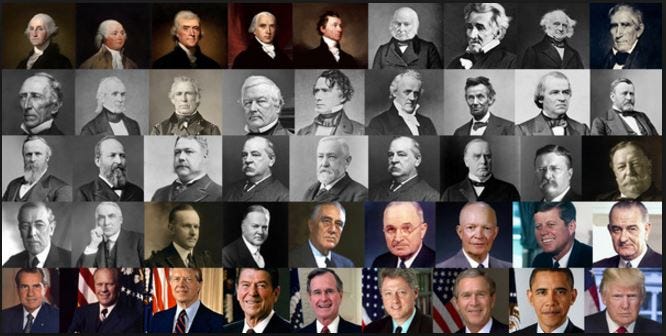
The office of the President was created in 1789 when George Washington was unanimously elected via the first balloter higher. From the fourth dimension he took office, it was determined that a presidential term shall be four years but without a limit on number of terms. He served until 1797 and chose non to run for a 3rd term, setting a precedent of two terms. The length of office, yet, was not really regulated until the 22nd amendment in 1951. Jefferson, the third President of the U.s. e'er believed that ii terms was plenty for one person, and that any more would be an overextension of executive power. After Washington and Jefferson, ii terms became the unofficial standard.
Afterward Franklin D. Roosevelt was elected president for a fourth term, the 22nd Amendment imposing a two-term limit for sitting presidents was proposed and subsequently passed past congress in 1947 and officially ratified by a majority of states in 1951. The subpoena states:
No person shall be elected to the office of the President more than twice, and no person who has held the office of President, or acted as President, for more than 2 years of a term to which some other person was elected President shall exist elected to the office of the President more than once. But this article shall not utilise to any person holding the office of President when this article was proposed by the Congress, and shall non prevent any person who may be holding the office of President, or acting as President, during the term within which this commodity becomes operative from holding the office of President or acting as President during the remainder of such term.
First, let's practise a quick history lesson about the Presidents. Donald Trump is the 45th President of the United States, but in that location have only been 44 men (hopefully one twenty-four hour period nosotros won't have to use that qualifier) who have served in this office. Grover Cleveland served two non-consecutive terms and is therefore counted as both the 22nd and 24th President. The shortest presidency was Harrison who died 31 days after taking role and the longest was Franklin D. Roosevelt who served 12 years, dying shortly after starting a 4th term and likewise acting equally the just President to serve more than two terms.
Eight of the Presidents died in office; four of natural causes (William Henry Harrison, Zachary Taylor, Warren G. Harding, and Franklin D. Roosevelt), 4 were assassinated (Abraham Lincoln, James A. Garfield, William McKinley and John F. Kennedy). At that place have been 11 one-term presidents throughout history but simply three since WWII (Gerald Ford, Jimmy Carter, and George HW Bush), all of whom ran but lost when seeking a 2nd term.
So, which Presidents made the witting determination to not run for a 2d term?
James Knox Polk (1845–1849)
Polk served as the Speaker of the House but was non a likely candidate for President. He was elected every bit the Democratic nominee in 1844 and ran on the promise that he wouldn't run for re-ballot. He had four goals during his term which were: tariff reduction, the reestablishment of an independent treasury, the looting of Oregon, and the conquering of California from Mexico. He was able to attain all four goals by the cease of his term making him one of America'southward most constructive ane-term presidents. True to his word, he did not seek re-election in 1848.
James Buchanan (1857–1861)
Buchanan was showtime in the United states of america House of Representatives then became Secretary of State under Polk. Afterwards winning the Presidential election, he did a good job of pissing off both Republican abolitionists and Norther democrats, earning him the nickname "doughface", a term used to depict a Northerner with Southern sympathies. During the financial Panic of 1857, Buchanan stated that he would non exist seeking a second term. He is also the only president to have remained a lifelong bachelor.
Rutherford B. Hayes (1877–1881)
Hayes was a lawyer in Ohio and a staunch abolitionist. He became governor and eventually was nominated past the Republican party and later on won a highly controversial election. He lost the pop vote but was awarded 20 contested balloter votes which pushed him over the border in the electoral college and resulted in the Compromise of 1877, where the Democrats allowed Hayes to accept the Presidency if he withdrew the remaining U.S. troops protecting Republican office holders in the S, and officially end the Reconstruction era. Hayes had pledged to not run for re-ballot and held up his end of the bargain. I interesting factoid about the Hayes White Firm was that it was booze-complimentary. His married woman Lucy was against alcohol and Hayes himself was upset over drunkenness he witnessed at gatherings and events so he banned it during his term.
Calvin Coolidge (1923–1929)
Coolidge became President in 1923 when Warren Harding died then won the election of 1924. Up until this time, no President had served for more than than 8 years and Coolidge felt that 10 years was just too long. In addition, his 16-twelvemonth old son died of blood poisoning in 1924 sending him into low. Known equally a homo of few words, in 1928 Coolidge handed a few reports a note with the discussion "I practise not cull to run for President in 1928" on information technology, and that was that.
Harry S. Truman (1945–1953)
I'grand not certain how to count Truman since he served virtually ii full terms. He assumed the Presidency in 1945, 82 days into his Vice Presidency, when Franklin D. Roosevelt died. He is known for implementing the Marshall Program to rebuild the economy of Western Europe after WWII, and establishing the Truman Doctrine and NATO. He came from behind to win the election in 1948 and his inauguration in 1949 was the commencement ever to be televised. In 1951, the 22nd amendment was ratified during his term making a president ineligible for ballot to a third term or for election to a second full term after serving more than two remaining years of a term of a previously elected president. They added a grandpa clause which excluded the incumbent president which meant that Truman was free to run again in 1952. He originally intended to run only was talked out of it due to his age and low approval rating in the polls.
Lyndon B. Johnson (1963–1969)
Johnson, similar Coolidge, actually served 6 years from 1963 to 1969 but was really a 1-term President. He took role later John F. Kennedy was assassinated (he was the VP) and won an election on his own. He was severely criticized for his handling of the Vietnam War and decided not to run for a second term in 1968. The same day he announced he wouldn't be running, he also appear he would cease all U.South. bombing of Northward Vietnam and seek a negotiated end to the war.
A few Presidents were unable to win the nomination of their parties and were therefore prevented from running for a 2nd term. These include Chester Alan Arthur, Andrew Johnson, Franklin Pierce, Millard Fillmore, and John Tyler.
jacksonyoulderven.blogspot.com
Source: https://medium.com/useless-knowledge-daily/which-us-presidents-chose-not-to-run-for-a-second-term-eba9cb2660cb
0 Response to "Who Did Jfk Run Again Become President"
Post a Comment